
Reading Time: 10–12 Minutes
Feed Conversion Ratio (FCR): The Most Important Number Every Broiler Farmer Should Know
Imagine two farmers raising 10,000 broiler chickens under similar conditions. At the end of the production cycle, both farmers sell birds of almost the same weight. However, one farmer spends significantly less on feed than the other and earns thousands more in profit.
What made the difference?
The answer lies in one of the most important performance indicators in poultry farming—Feed Conversion Ratio (FCR).
Feed typically accounts for 60–70% of the total cost of broiler production, making it the single largest expense on a commercial poultry farm. Every kilogram of feed saved without compromising bird growth directly improves profitability. This is why successful poultry producers, nutritionists, and farm managers monitor FCR closely throughout every production cycle.
Whether you are a small-scale poultry farmer or managing a commercial broiler enterprise, understanding FCR can help you reduce production costs, improve bird performance, and make more informed management decisions.
In this comprehensive guide, you’ll learn:
- What Feed Conversion Ratio (FCR) is
- Why FCR is critical to profitability
- How to calculate FCR accurately
- What constitutes a good FCR
- The main factors influencing feed efficiency
- Practical strategies to improve FCR on your farm
- How digital technologies and artificial intelligence can help optimize broiler performance
What is Feed Conversion Ratio (FCR)?
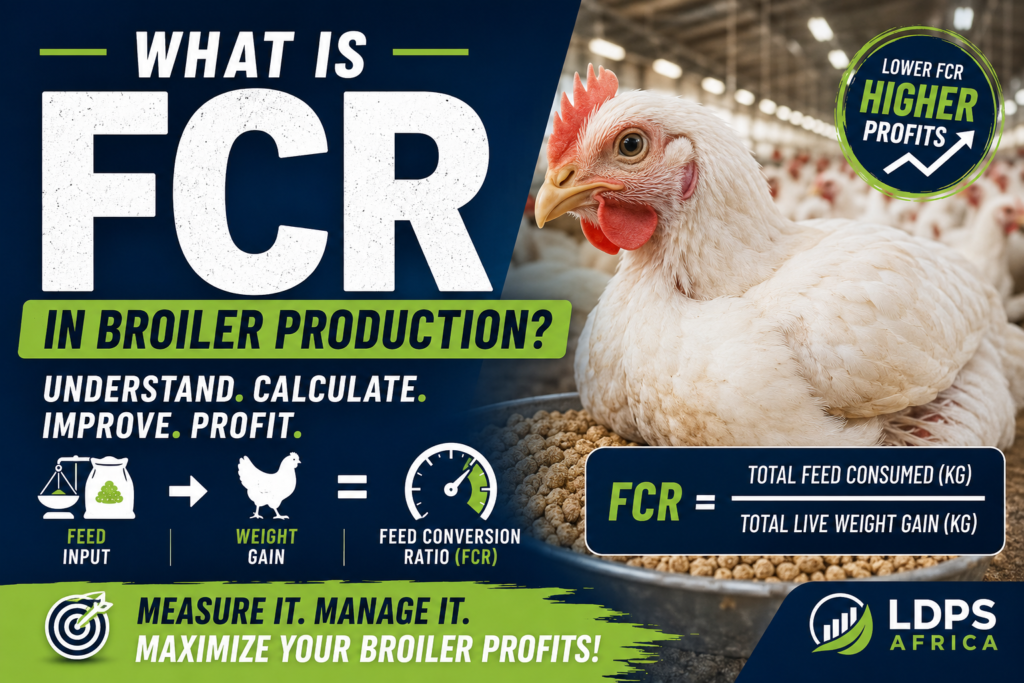
Feed Conversion Ratio (FCR) is a measure of how efficiently broiler chickens convert feed into body weight.
Simply put, it tells you how many kilograms of feed are required to produce one kilogram of live weight gain.
The lower the FCR, the more efficiently birds utilise feed.
For example:
- An FCR of 1.50 means the birds require 1.50 kg of feed to gain 1 kg of body weight.
- An FCR of 1.90 means the birds require 1.90 kg of feed to gain 1 kg of body weight.
Since feed is the largest production cost, even a small improvement in FCR can result in substantial savings over thousands of birds.
Lower FCR = Better Performance
A lower FCR generally indicates:
- Better feed efficiency
- Lower production costs
- Improved profitability
- Healthier birds
- Better management practices
Conversely, a high FCR often signals underlying issues such as poor nutrition, disease, environmental stress, or management challenges that require attention.
Why is Feed Conversion Ratio Important?
Many farmers focus primarily on bird weight at market age. While achieving target weights is important, how efficiently birds reach those weights is even more critical.
A farm producing heavy birds with excessive feed consumption may earn less profit than a farm producing slightly lighter birds with excellent feed efficiency.
Monitoring FCR provides valuable insights into several aspects of farm performance:
1. Reduces Feed Costs
Feed represents the largest operational expense in broiler production. Improving feed efficiency reduces the amount of feed required to produce each kilogram of meat, lowering overall production costs.
2. Improves Profitability
Every improvement in FCR contributes directly to profit margins. Lower feed costs mean more income is retained after sales, improving the financial performance of the enterprise.
3. Measures Overall Farm Performance
FCR reflects the combined impact of genetics, nutrition, management, health, water quality, housing conditions, and environmental control. It serves as a comprehensive indicator of production efficiency.
4. Supports Better Decision-Making
Tracking FCR helps identify production problems early, allowing farmers to implement corrective measures before losses become significant.
5. Enables Benchmarking
Comparing FCR against industry standards or previous production cycles helps farmers evaluate performance and identify opportunities for continuous improvement.
How is Feed Conversion Ratio Calculated?
Calculating FCR is straightforward.
Formula:
FCR = Total Feed Consumed ÷ Total Live Weight Gain
Example
Suppose a flock consumes:
- Total feed consumed: 15,000 kg
- Total live weight produced: 10,000 kg
The calculation becomes:
FCR = 15,000 ÷ 10,000 = 1.50
This means the birds required 1.50 kg of feed to produce 1 kg of live body weight.
Accurate FCR calculations depend on reliable records of feed deliveries, feed consumption, bird weights, mortality, and production performance.
What is Considered a Good Feed Conversion Ratio?
The ideal FCR depends on several factors, including bird genetics, age, feed quality, environmental conditions, and management practices.
As a general guide:
| Market Age | Good FCR |
|---|---|
| 21 Days | 1.20–1.30 |
| 28 Days | 1.35–1.45 |
| 35 Days | 1.45–1.55 |
| 42 Days | 1.55–1.70 |
While these values provide useful benchmarks, each farm should compare its performance against similar production systems and historical records.
Factors Affecting Feed Conversion Ratio
Achieving excellent FCR requires attention to multiple interacting factors.
1. Nutrition
Balanced diets are fundamental to efficient growth.
Feed should provide:
- Adequate energy
- High-quality protein
- Essential amino acids
- Vitamins
- Minerals
- Digestible ingredients
Poor feed quality often results in higher feed intake without proportional weight gain.
2. Genetics
Modern broiler strains have been selectively bred for rapid growth and efficient feed utilisation.
Choosing high-performing breeds provides a strong foundation for achieving favourable FCR values.
3. Water Quality
Water is often overlooked despite being the most important nutrient.
Poor water quality can reduce feed intake, impair digestion, and negatively affect bird performance.
Clean, cool, and readily available drinking water is essential throughout the production cycle.
4. Disease and Health
Diseases reduce nutrient absorption and increase maintenance energy requirements.
Common diseases affecting FCR include:
- Coccidiosis
- Necrotic enteritis
- Respiratory infections
- Newcastle disease
- Infectious Bursal Disease (IBD)
Strong biosecurity programmes and vaccination schedules help maintain flock health and feed efficiency.
5. Environmental Conditions
Heat stress significantly reduces feed efficiency.
Poor ventilation, excessive humidity, wet litter, and overcrowding all increase stress and divert energy away from growth.
Maintaining optimal environmental conditions encourages birds to consume feed efficiently and achieve better weight gains.
6. Farm Management
Good management practices have a direct influence on FCR.
Examples include:
- Proper brooding
- Appropriate stocking density
- Consistent feeding schedules
- Adequate feeder and drinker space
- Minimising feed wastage
- Daily monitoring of bird behaviour
Small improvements in management often produce substantial improvements in feed efficiency.
Economic Impact of Poor Feed Conversion
The financial consequences of poor FCR can be significant.
Consider two farms, each producing 20,000 broilers with an average market weight of 2.2 kg.
Farm A achieves an FCR of 1.50, while Farm B records an FCR of 1.75.
Although both farms sell the same amount of meat, Farm B consumes thousands of additional kilograms of feed. At current feed prices, this difference can translate into a substantial increase in production costs and a significant reduction in profit.
This example illustrates why improving FCR by even 0.05–0.10 points can have a meaningful impact on financial performance.
Practical Ways to Improve Feed Conversion Ratio
Improving FCR requires a systematic approach rather than a single intervention.
Successful farms often focus on:
- Purchasing high-quality chicks from reputable suppliers.
- Providing balanced diets formulated for each growth stage.
- Maintaining excellent biosecurity.
- Ensuring unrestricted access to clean water.
- Reducing heat stress through proper ventilation.
- Preventing feed wastage by adjusting feeders correctly.
- Monitoring flock performance regularly.
- Recording key production data for each production cycle.
- Investigating performance deviations promptly.
- Consulting poultry nutritionists and veterinarians when necessary.
Continuous improvement is more effective than waiting until production problems become severe.
How Technology is Transforming Feed Efficiency
Modern poultry farming increasingly relies on digital technologies to improve production efficiency.
Instead of relying solely on manual records, producers can now use intelligent farm management platforms to monitor performance in real time.
Platforms such as LDPS Africa™ enable farmers to:
- Track Feed Conversion Ratio continuously.
- Compare flock performance with industry benchmarks.
- Analyse nutrition and production trends.
- Identify performance issues early.
- Generate executive reports automatically.
- Monitor feed costs and profitability.
- Receive AI-driven recommendations for improving farm performance.
Data-driven management allows farmers to move from reactive problem-solving to proactive decision-making.
Key Takeaways
Feed Conversion Ratio is more than just a production statistic—it is one of the strongest indicators of farm efficiency and profitability.
To maximise returns:
- Measure FCR consistently.
- Maintain accurate production records.
- Invest in quality nutrition.
- Prioritise flock health and welfare.
- Optimise environmental conditions.
- Use data and technology to guide management decisions.
Small improvements in feed efficiency, when applied consistently, can lead to significant financial gains over time.
Conclusion
Feed Conversion Ratio (FCR) remains one of the most important Key Performance Indicators (KPIs) in broiler production. By understanding what FCR is, how it is calculated, and the factors that influence it, poultry farmers can make informed decisions that improve productivity and profitability.
Success in modern poultry farming is no longer determined solely by how many birds reach market weight, but by how efficiently they get there. Efficient feed utilisation reduces costs, supports sustainable production, and strengthens the long-term competitiveness of the farm.
Whether you manage a small flock or a large commercial operation, monitoring and improving FCR should be a central part of your production strategy.
🚀 Improve Your Broiler Feed Efficiency with LDPS Africa™
Stop relying on guesswork and start making data-driven decisions.
With LDPS Africa™, you can:
- 📊 Monitor Feed Conversion Ratio in real time.
- 📈 Benchmark your farm against industry standards.
- 💰 Identify hidden feed costs and performance losses.
- 🤖 Receive AI-powered recommendations to improve productivity.
- 📑 Generate professional farm performance reports.
Ready to optimise your broiler performance?