
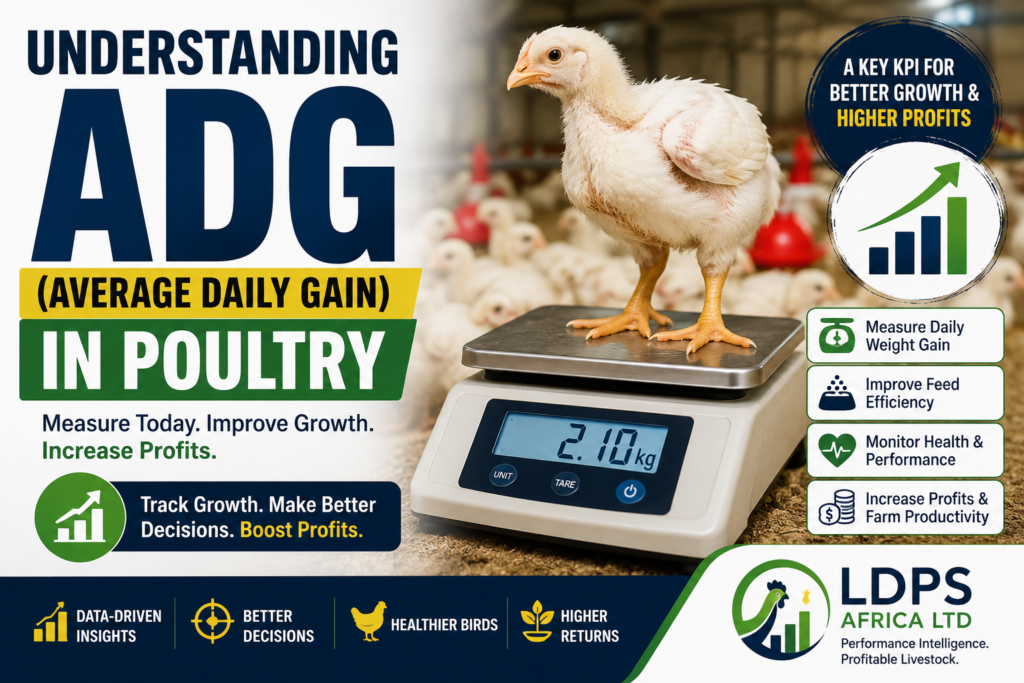
Average Daily Gain (ADG) in Poultry | Complete Farmer’s Guide
Understanding Average Daily Gain (ADG) in Poultry
Every poultry farmer wants birds that grow quickly, stay healthy, and reach market weight on time. However, achieving consistent growth requires more than providing feed and water. Farmers also need to measure how well their birds perform throughout the production cycle.
One of the most useful performance indicators is Average Daily Gain (ADG). This simple measurement shows how much weight each bird gains every day. As a result, it helps farmers evaluate nutrition, health, and management practices.
Moreover, ADG allows producers to identify growth problems before they become costly. Instead of waiting until marketing day, farmers can monitor progress weekly and make timely adjustments. Consequently, they can improve productivity, reduce production costs, and increase profitability.
Whether you manage a small flock or a large commercial poultry farm, understanding ADG is essential for making informed management decisions.
What is Average Daily Gain (ADG)?
Average Daily Gain (ADG) is the average amount of body weight a bird gains each day over a specific period.
It measures the rate at which birds convert nutrients into body mass.
Simply put,
ADG tells you how many grams each bird gains every day.
A higher ADG generally indicates healthier birds, better nutrition, effective management, and improved production efficiency.
Why is ADG Important?
Monitoring ADG helps farmers answer important questions such as:
- Are my birds growing according to breed standards?
- Is my feed programme working?
- Are birds healthy?
- Is feed quality adequate?
- Are environmental conditions affecting growth?
- Will birds reach market weight on time?
Without monitoring ADG, many production problems remain unnoticed until significant financial losses have already occurred.
How to Calculate Average Daily Gain
The formula is straightforward:
ADG = (Final Weight − Initial Weight) ÷ Number of Days
Example
Day-old chick weight:
45 g
Weight after 35 days:
2,100 g
Weight gained:
2,100 − 45 = 2,055 g
ADG:
2,055 ÷ 35 = 58.7 g/day
This means each bird gained approximately 59 grams per day.
Example ADG Calculation Table
| Age | Body Weight |
|---|---|
| Day 1 | 45 g |
| Day 7 | 180 g |
| Day 14 | 480 g |
| Day 21 | 930 g |
| Day 28 | 1.50 kg |
| Day 35 | 2.10 kg |
Weight gain:
2.10 kg − 45 g = 2.055 kg
ADG:
2.055 kg ÷ 35 = 58.7 g/day
What is a Good ADG in Broiler Chickens?
ADG depends on:
- Genetics
- Nutrition
- Management
- Environmental conditions
- Production system
Typical commercial targets are:
| Production Stage | Expected ADG |
|---|---|
| Week 1 | 18–22 g/day |
| Week 2 | 40–50 g/day |
| Week 3 | 55–65 g/day |
| Week 4 | 65–75 g/day |
| Week 5 | 70–80 g/day |
| Overall Production | 55–70 g/day |
Modern commercial broiler strains under excellent management may exceed these values.
Factors Affecting Average Daily Gain
1. Nutrition
Nutrition has the greatest influence on ADG.
Birds require:
- Balanced protein
- Adequate energy
- Essential amino acids
- Vitamins
- Minerals
- Clean water
Poor-quality feed immediately reduces growth rates.
2. Feed Intake
Birds that eat less gain less weight.
Reduced feed intake may result from:
- Heat stress
- Disease
- Poor feed quality
- Inadequate feeder space
- Water shortages
3. Genetics
Different poultry breeds have different growth potentials.
Commercial broiler strains are specifically selected for rapid growth and high ADG.
4. Disease
Health challenges significantly reduce growth.
Common examples include:
- Coccidiosis
- Newcastle disease
- Infectious Bursal Disease
- Chronic Respiratory Disease
- Salmonellosis
Healthy birds consistently achieve higher ADG.
5. Water Availability
Water is often overlooked.
Birds consume approximately 1.6–2.0 litres of water for every kilogram of feed consumed, depending on environmental conditions.
Restricted water intake immediately reduces feed consumption and weight gain.
6. Temperature
Birds perform best within their thermal comfort zone.
When temperatures are too high:
- Feed intake decreases
- Growth slows
- ADG drops
When temperatures are too low:
- Energy is diverted to maintaining body temperature instead of growth.
7. Stocking Density
Overcrowding reduces:
- Feed access
- Water access
- Air quality
- Bird comfort
This ultimately lowers ADG.
8. Lighting Programme
Proper lighting encourages:
- Feeding
- Drinking
- Rest
- Growth
Poor lighting schedules can reduce performance.
Relationship Between ADG and Feed Conversion Ratio (FCR)
ADG and FCR are closely linked.
High-performing flocks usually have:
- High ADG
- Low FCR
- Lower production costs
- Better profitability
However, increasing ADG without maintaining feed efficiency may increase feed costs.
The goal is to optimise both ADG and FCR simultaneously.
ADG and Poultry Profitability
Higher ADG leads to several financial benefits:
- Earlier market age
- Reduced feed costs per kilogram of meat
- Better house utilisation
- Increased annual production cycles
- Improved cash flow
- Higher farm profitability
Every additional gram of daily gain contributes to greater production efficiency.
How to Improve Average Daily Gain
Farmers can improve ADG by implementing the following practices:
Optimise Nutrition
- Use high-quality feed ingredients
- Balance amino acids
- Formulate diets according to growth stage
Maintain Excellent Biosecurity
- Prevent disease outbreaks
- Vaccinate appropriately
- Control visitors and equipment movement
Monitor Body Weight Weekly
Weigh representative samples of birds each week.
Compare results against breed standards.
Early detection allows timely corrective action.
Improve Water Quality
Provide:
- Clean water
- Cool water
- Adequate drinkers
- Regular sanitation
Maintain Proper Ventilation
Good ventilation:
- Removes ammonia
- Supplies fresh oxygen
- Controls humidity
- Reduces stress
Reduce Heat Stress
Use:
- Fans
- Cooling systems
- Adequate ventilation
- Proper stocking density
Minimise Feed Wastage
Ensure:
- Correct feeder height
- Appropriate feeder space
- Good feed quality
- Proper feed storage
Common Mistakes Farmers Make
Many poultry producers unknowingly reduce ADG by:
- Using poor-quality feed
- Ignoring weekly weighing
- Overcrowding birds
- Poor litter management
- Delayed disease treatment
- Inadequate water supply
- Poor ventilation
- Inconsistent feeding schedules
Correcting these issues often leads to immediate improvements in growth performance.
Using ADG Together with Other KPIs
ADG should never be analysed in isolation.
For a complete picture of flock performance, monitor:
- Feed Conversion Ratio (FCR)
- Mortality Rate
- Feed Intake
- Uniformity
- Body Weight
- European Production Efficiency Factor (EPEF)
- Livability
- Production Cost per Kilogram
Together, these KPIs provide a comprehensive assessment of flock health, productivity, and profitability.
Frequently Asked Questions (FAQs)
What is the ideal ADG for broilers?
Most commercial broilers achieve an overall ADG of 55–70 grams per day, depending on genetics and management.
Why is my flock’s ADG low?
Common causes include poor nutrition, disease, heat stress, inadequate water, poor ventilation, overcrowding, or suboptimal management.
How often should ADG be measured?
Weekly weighing of representative birds is recommended to monitor growth trends and detect issues early.
Does higher ADG always mean higher profits?
Not necessarily. High ADG should be achieved alongside good feed efficiency, low mortality, and controlled production costs to maximise profitability.
Final Thoughts
Average Daily Gain is more than just a growth measurement—it is a powerful management tool that reflects the effectiveness of nutrition, health, environment, and overall flock management.
By tracking ADG consistently and combining it with other key performance indicators such as Feed Conversion Ratio (FCR), mortality, and feed intake, poultry farmers can make informed decisions that improve productivity and increase profitability.
In today’s data-driven poultry industry, measuring performance is no longer optional. Farms that monitor, analyse, and act on performance data are better positioned to achieve sustainable growth, reduce costs, and remain competitive.
Key Takeaways
- ✅ ADG measures the average weight gained per bird per day.
- ✅ Formula: (Final Weight − Initial Weight) ÷ Number of Days
- ✅ Good ADG reflects effective nutrition, health, and management.
- ✅ Monitor ADG weekly to identify growth issues early.
- ✅ Optimise feed, water, biosecurity, ventilation, and stocking density to improve ADG.
- ✅ Use ADG alongside FCR, mortality, and EPEF for a complete view of flock performance.
- ✅ Data-driven monitoring supports better decisions and higher profitability.
Call to Action
📈 Want to improve your flock’s growth and profitability?
LDPS Africa Ltd helps poultry farmers, feed companies, and agribusinesses unlock better performance through data-driven analytics, nutrition advisory, feed formulation support, and precision livestock management.
Whether you’re tracking ADG, improving Feed Conversion Ratio (FCR), or building a complete poultry performance dashboard, our team can help you turn production data into profitable decisions.
Contact LDPS Africa Ltd today to discover how performance intelligence can transform your poultry enterprise.