
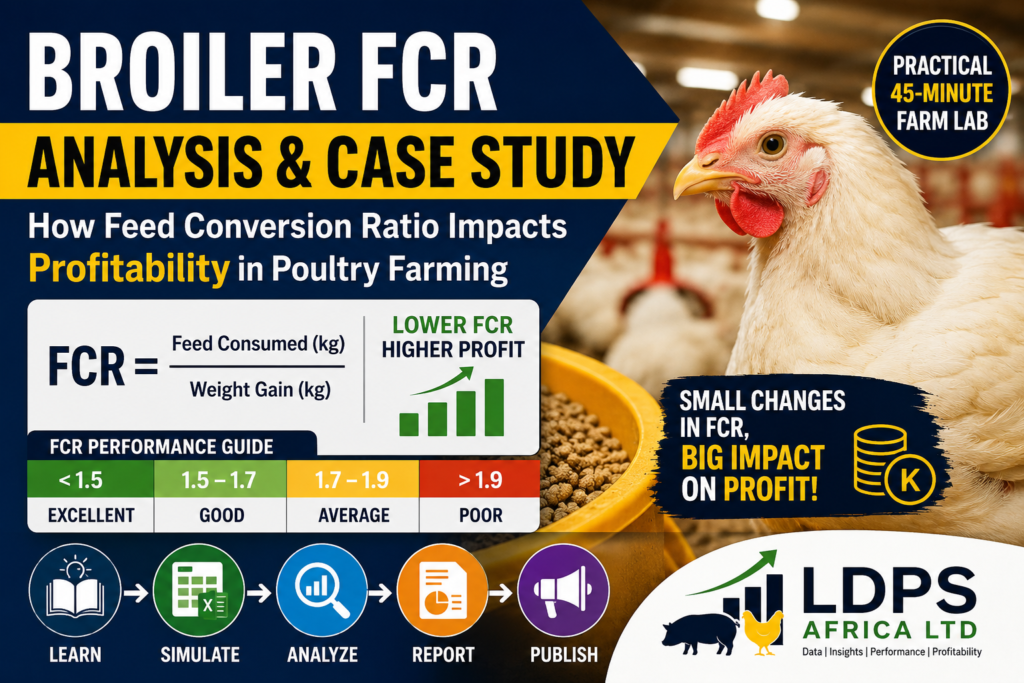
Broiler Feed Conversion Ratio (FCR): A Practical Farm Performance Analysis and Profitability Case Study
Understanding Feed Conversion Ratio in Poultry Production
Feed accounts for approximately 65–75% of total broiler production costs, making Feed Conversion Ratio (FCR) one of the most important Key Performance Indicators (KPIs) in poultry farming.
Yet many poultry producers focus primarily on growth rates and final weights while overlooking feed efficiency. Small differences in FCR can significantly affect farm profitability, especially in large commercial operations.
This practical case study demonstrates how FCR analysis can be used to evaluate broiler house performance, identify inefficiencies, and improve financial outcomes.
What is Feed Conversion Ratio (FCR)?
Feed Conversion Ratio measures how efficiently birds convert feed into body weight gain.
FCR is calculated as:
FCR = Feed Consumed (kg) ÷ Weight Gain (kg)
Interpreting FCR Values
| FCR Range | Performance Level |
| Below 1.5 | Excellent |
| 1.5 – 1.7 | Good |
| 1.7 – 1.9 | Average |
| Above 1.9 | Poor |
The lower the FCR, the more efficiently birds convert feed into body weight, resulting in lower production costs and higher profitability.
Practical Poultry Farm Simulation
To demonstrate the value of FCR analysis, a simulated broiler farm consisting of five production houses was evaluated.
Farm Dataset
| House | Birds Placed | Feed Consumed (kg) | Final Live Weight (kg) |
| A | 1,000 | 3,400 | 2,100 |
| B | 1,000 | 3,600 | 2,050 |
| C | 1,000 | 3,300 | 2,150 |
| D | 1,000 | 3,900 | 2,200 |
| E | 1,000 | 3,500 | 2,180 |
Initial chick weight for each flock was assumed to be 40 kg.
Step 1: Calculate Weight Gain
Weight Gain = Final Live Weight − Initial Weight
| House | Weight Gain (kg) |
| A | 2,060 |
| B | 2,010 |
| C | 2,110 |
| D | 2,160 |
| E | 2,140 |
Step 2: Calculate Feed Conversion Ratio
| House | FCR |
| A | 1.65 |
| B | 1.79 |
| C | 1.56 |
| D | 1.81 |
| E | 1.64 |
House Ranking by FCR
| Rank | House | FCR |
| 1 | C | 1.56 |
| 2 | E | 1.64 |
| 3 | A | 1.65 |
| 4 | B | 1.79 |
| 5 | D | 1.81 |
Key Findings
Best Performing House
House C achieved the best FCR of 1.56.
This indicates excellent feed efficiency and suggests effective management practices, optimal feed utilization, and good bird health status.
Worst Performing House
House D recorded the highest FCR at 1.81.
Although birds achieved the highest final live weight, more feed was required per kilogram of weight gain, reducing overall efficiency and profitability.
Average Farm FCR
The average FCR across all five houses was 1.69.
This falls within the “Good” performance category but indicates room for improvement.
Financial Impact of FCR Differences
Many producers underestimate the financial consequences of FCR variation.
Assuming feed costs KES 60 per kilogram:
Feed Cost Per House
| House | Feed Consumed (kg) | Feed Cost (KES) |
| A | 3,400 | 204,000 |
| B | 3,600 | 216,000 |
| C | 3,300 | 198,000 |
| D | 3,900 | 234,000 |
| E | 3,500 | 210,000 |
House D consumed KES 36,000 more feed than House C.
This difference occurred despite similar production performance.
When multiplied across multiple production cycles and larger farm populations, small FCR differences can result in hundreds of thousands or even millions of shillings in additional feed costs annually.
Potential Causes of Poor FCR
Several factors can contribute to higher FCR values:
Feed Wastage
Poor feeder adjustment and excessive feed spillage increase feed consumption without corresponding weight gain.
Disease Challenges
Subclinical disease can reduce nutrient utilization and growth performance.
Poor Brooding Management
Inadequate brooding conditions negatively affect early chick development and feed efficiency.
Water Management Problems
Insufficient water access can reduce feed intake efficiency and growth.
Heat Stress
High environmental temperatures often lead to poorer feed conversion and reduced productivity.
Feed Quality Issues
Low nutrient density, poor ingredient quality, or feed contamination can adversely affect growth performance.
Recommendations for Improving FCR
Based on this analysis, poultry producers should:
1. Monitor FCR Weekly
Routine performance monitoring helps identify inefficiencies before they become costly.
2. Benchmark Production Houses
Comparing houses allows managers to identify best-performing units and replicate successful practices.
3. Audit Feed Management Systems
Regular inspection of feeders can significantly reduce feed wastage.
4. Strengthen Biosecurity Programs
Reducing disease pressure improves nutrient utilization and overall performance.
5. Optimize Environmental Conditions
Proper ventilation, temperature control, and water availability improve bird comfort and feed efficiency.
Why Every Poultry Farm Should Track FCR
FCR is more than a production metric.
It is a profitability indicator.
By translating biological performance into economic outcomes, FCR enables farm managers to make informed decisions regarding nutrition, health management, housing, and operational efficiency.
The farms that consistently measure, analyze, and improve FCR are often the farms that achieve the highest levels of profitability and competitiveness.
Conclusion
This practical broiler farm simulation demonstrates that even small differences in Feed Conversion Ratio can have substantial financial implications.
House C emerged as the most efficient unit with an FCR of 1.56, while House D recorded the lowest efficiency at 1.81. Although all houses achieved acceptable performance, targeted interventions could further improve feed utilization and profitability.
The key lesson is simple:
Measure performance before making decisions.
Feed Conversion Ratio remains one of the most powerful tools available for improving broiler production efficiency, controlling feed costs, and maximizing farm profits.
LDPS Africa Ltd helps poultry, pig, and livestock enterprises improve profitability through livestock performance analytics, nutrition economics, farm audits, KPI dashboards, and decision-support systems.
By transforming farm data into actionable insights, LDPS Africa enables producers to identify losses, improve efficiency, and make evidence-based management decisions.