
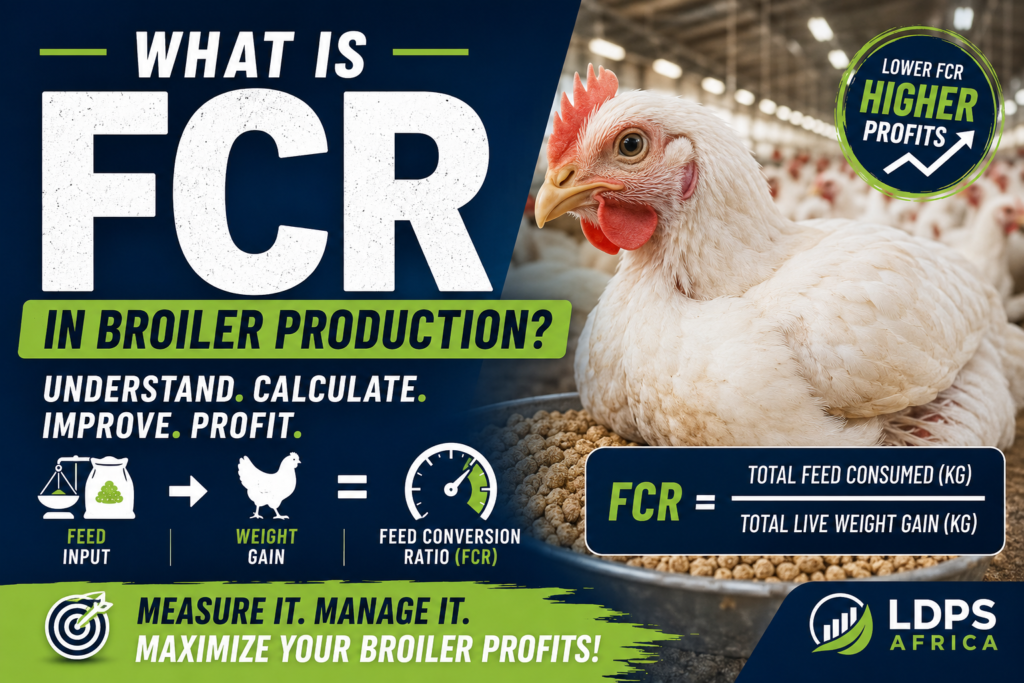
What is Feed Conversion Ratio (FCR) in Broiler Production?
Introduction
In commercial broiler production, feed accounts for approximately 60–75% of total production costs. This makes feed management the single most important factor affecting profitability. A farm may have excellent housing, healthy birds, and skilled staff, but if feed is not converted efficiently into body weight, profitability declines rapidly.
This is why Feed Conversion Ratio (FCR) is regarded as one of the most important Key Performance Indicators (KPIs) in poultry production. It measures how efficiently birds convert feed into live body weight and serves as a direct indicator of production efficiency, nutrition effectiveness, flock health, and overall farm management.
Whether you are a farmer, nutritionist, veterinarian, consultant, or investor, understanding FCR is essential for making informed decisions that improve productivity and profitability.
What is Feed Conversion Ratio (FCR)?
Feed Conversion Ratio (FCR) is the amount of feed required for a broiler to gain one kilogram of live body weight.
In simple terms:
FCR tells you how many kilograms of feed are needed to produce one kilogram of chicken meat.
The lower the FCR, the more efficient the flock.
For example:
FCR = 1.45
Birds require 1.45 kg of feed to gain 1 kg of body weight.
FCR = 1.80
Birds require 1.80 kg of feed to gain 1 kg of body weight.
Clearly, the flock with an FCR of 1.45 is more efficient because it produces the same weight gain using less feed.
Feed Conversion Ratio Formula
The standard formula is:
FCR = Total Feed Consumed (kg) ÷ Total Live Weight Gain (kg)
Example
Suppose a flock:
Consumes 4,500 kg of feed
Produces 3,000 kg of live weight gain
FCR = 4,500 ÷ 3,000 = 1.50
This means the flock required 1.50 kg of feed to produce 1 kg of live weight gain.
Why is FCR Important?
FCR is much more than a nutrition metric. It reflects the combined effects of:
📌Feed quality
📌Nutrition program
📌Genetics
📌Bird health
📌Environmental management
📌Water availability
📌Stockmanship
📌Biosecurity
📌Disease control
A poor FCR often indicates that one or more aspects of production require attention.
🐔 Why Every Poultry Farmer Should Monitor FCR
Monitoring FCR helps producers:
📊 Measure production efficiency
📈 Compare flock performance over time
🎯 Benchmark against industry standards
🚨 Detect management problems early
🌾 Evaluate feed quality
🥣 Assess nutrition programs
💰 Improve profitability
📋 Support investment decisions
💸 Reduce production costs
🏆 Increase competitiveness
Ideal Feed Conversion Ratio in Broilers
Although targets vary with genetics, nutrition, age at slaughter, and management, the following ranges are commonly used:
FCR Interpretation
Below 1.40 Outstanding
1.40–1.50 Excellent
1.50–1.60 Very Good
1.60–1.70 Good
1.70–1.80 Average
Above 1.80 Poor – investigate causes
Actual targets should always be interpreted alongside body weight, age, mortality, and market requirements.
Global Performance Benchmarks
Leading commercial broiler operations often achieve:
Market age: 35–42 days
Average daily gain: 60–70 g/day
FCR: 1.35–1.55
European Production Efficiency Factor (EPEF): >400
These values vary depending on genetics, climate, feed ingredients, and management.
Typical African Benchmarks
Many commercial farms in Africa operate under additional challenges such as:
🔍High environmental temperatures
🔍Variable feed ingredient quality
🔍Disease pressure
🔍Water quality issues
🔍Limited climate control
🔍Inconsistent feed manufacturing
As a result, FCR values around 1.55–1.75 are commonly observed, with well-managed farms increasingly approaching global standards.
Factors That Affect Feed Conversion Ratio
1. Nutrition
Balanced diets provide birds with the nutrients needed for efficient growth.
Poor feed formulation increases FCR because birds consume feed without converting it effectively into muscle.
Important nutritional factors include:
– Energy level
– Protein quality
-Amino acid balance
– Digestibility
– Enzyme supplementation
– Mineral balance
– Vitamin adequacy
2. Feed Quality
Feed consistency is critical.
Problems include:
– Mycotoxins
– Rancid fats
– Poor ingredient quality
– Incorrect particle size
– Feed segregation
– Low pellet durability
3. Genetics
Modern broiler strains have been genetically selected for excellent feed efficiency.
Using poor-quality chicks or mixed genetics often reduces performance.
4. Water Availability
Water is often called the forgotten nutrient.
Restricted water intake immediately reduces:
– Feed intake
– Growth
– Digestibility
– Feed efficiency
5. Disease
Diseases divert nutrients from growth toward immune responses.
Examples include:
– Coccidiosis
– Necrotic enteritis
– Respiratory diseases
– Infectious bursal disease
Even subclinical infections can significantly worsen FCR.
6. Environment
Environmental stress reduces feed efficiency.
Key factors include:
– Heat stress
– Poor ventilation
– High ammonia
– Wet litter
– Overcrowding
7. Management
Good management practices improve FCR by ensuring birds experience minimal stress.
These include:
– Correct stocking density
– Proper brooding
– Biosecurity
– Vaccination
– Lighting programs
– Uniform feeding
Economic Impact of Poor FCR
Even a small deterioration in FCR can dramatically increase feed costs.
Example
Farm size:
10,000 broilers
Final body weight:
2.2 kg
Difference:
Improving FCR from 1.70 to 1.60 saves 0.10 kg of feed per kilogram of weight gain.
For a flock producing 22,000 kg of live weight, this equals:
0.10 × 22,000 = 2,200 kg of feed saved
If feed costs KES 60 per kg, the savings are:
2,200 × 60 = KES 132,000
This demonstrates why seemingly small improvements in FCR can have a substantial impact on profitability.
Common Causes of Poor FCR
– Low-quality chicks
– Poor brooding
– Heat stress
– Nutritional deficiencies
– Poor feed mixing
– Inadequate water
– Mycotoxins
– Disease outbreaks
– Poor ventilation
– Wet litter
– Overstocking
– Feed wastage
– Equipment failure
– Inconsistent lighting
How to Improve Feed Conversion Ratio
Successful farms focus on continuous improvement through:
Nutrition
– Balanced feed formulation
– High-quality ingredients
– Digestible amino acids
– Feed additives where appropriate
Health
– Strong biosecurity
– Effective vaccination
– Parasite control
– Early disease detection
Management
– Good chick placement
– Temperature control
– Ventilation management
– Uniform feeding
– Clean water
Monitoring
– Weekly body weight
– Daily feed intake
– Water consumption
– Mortality
– FCR trends
– Benchmark comparisons
Using AI to Improve FCR
Modern precision livestock systems can analyze flock data continuously to:
– Detect declining FCR trends early
– Predict feed inefficiencies
– Compare performance with benchmarks
– Estimate financial losses
– Recommend corrective actions
– Generate automated performance reports
– AI-driven decision support enables faster interventions and more consistent production outcomes.
Key Takeaways
Feed Conversion Ratio is one of the most important indicators of broiler farm efficiency because it directly links biological performance to economic outcomes. A lower FCR means birds require less feed to achieve the same weight gain, reducing production costs and improving profitability. While genetics play a role, nutrition, health, water management, environmental conditions, and day-to-day management practices all influence feed efficiency. By routinely monitoring FCR, benchmarking results, and using data-driven tools to identify improvement opportunities, poultry producers can make informed decisions that strengthen both productivity and long-term business performance.
Frequently Asked Questions (FAQs)
1. What is a good FCR for broilers? An FCR between 1.40 and 1.60 is generally considered very good in commercial production, depending on age, genetics, and management.
2. Can poor water quality affect FCR? Yes. Inadequate water quality or availability reduces feed intake, digestion, and growth, leading to poorer feed efficiency.
3. Is FCR affected by heat stress? Absolutely. Heat-stressed birds eat less, divert energy to cooling themselves, and convert feed less efficiently.
4. Why should FCR be monitored alongside other KPIs? FCR provides greater value when interpreted with metrics such as Average Daily Gain (ADG), mortality, feed intake, body weight, and EPEF, giving a more complete picture of flock performance.